String and Linear Foreign Bodies in Cats: A Vet Guide

Most owners know that cats should not swallow things they are not meant to. Fewer know that among all the objects a cat can swallow, long thin ones are in a category of their own. Veterinarians call these linear foreign bodies — string, sewing thread, dental floss, ribbon, tinsel, elastic hair ties, shoelaces, fishing line, and the strings from a roast joint of meat.
The reason they are singled out is mechanical. A round object may pass through the digestive tract or lodge in one place. A long strip behaves very differently, and can damage a long stretch of intestine rather than a single point. That difference turns what sounds like a minor mishap into one of the more serious emergencies in feline medicine. This guide explains why, what to look for, and what to do — and, just as importantly, what not to do.
Important: This article shares general educational information for pet owners and is not a substitute for an in-person veterinary examination, diagnosis, or treatment. For any medical concern or emergency, contact your veterinarian promptly.
Why Cats Are Especially at Risk
Cats are built to chase and catch small moving things. A dangling ribbon or a thread trailing across the floor moves exactly like prey, which is why cats find it so hard to ignore. Play and hunting behaviour are not faults to be trained out; they are core feline needs. The problem is that our homes are full of prey-shaped objects that were never meant to be swallowed.
There is also an anatomical factor. A cat's tongue is covered in backward-facing barbs that are excellent for grooming and for stripping meat from bone. They also make it nearly impossible for a cat to spit something out once it is partway down. Anything that reaches the back of the tongue tends to go one way: onwards.
So a cat that starts playing with a piece of thread and then finds the end in its mouth frequently ends up swallowing it, not because it wanted to eat it, but because the alternative is mechanically difficult. Understanding this removes any sense of blame and shifts the focus to where it belongs: keeping these items out of reach.
What Makes a Linear Foreign Body Different
When a long strip is swallowed, one end frequently catches and anchors — commonly around the base of the tongue, or further along at the outflow of the stomach. The rest continues to travel forward as the intestines contract in their normal rhythm.
Because one end cannot move, the intestine effectively pulls itself along the fixed strand and gathers up like fabric being drawn onto a thread. The bowel bunches into concertina folds, and the taut strand presses against the inner wall along that stretch. Over time that pressure can damage the intestinal wall in multiple places rather than one.
This is why veterinarians treat suspected linear foreign bodies with real urgency and why it is not a wait-and-see situation. The consequences are not simply blockage; they include the possibility of injury along a substantial length of the digestive tract. Early assessment gives the best chance of a straightforward outcome.
The Everyday Culprits in a Normal Home
Almost every household contains several of these. Recognising them is the first step in prevention.
- Sewing thread, embroidery floss and yarn. Particularly dangerous when a needle is still attached.
- Elastic hair ties and rubber bands. Extremely common, and often left on bathroom counters and bedside tables.
- Ribbon, gift string and curling ribbon. A seasonal spike in incidents follows gift-giving occasions.
- Tinsel and decorative garland. Shiny, moving, and irresistible to many cats.
- Dental floss and floss picks. Often flavoured and scented, and usually discarded in an open bin.
- Butcher's string and roasting twine. Coated in meat juices, which makes it doubly attractive.
- Shoelaces, drawstrings and blind cords. Dangling cords also present a strangulation risk.
- Fishing line and kite string. Frequently found around holiday homes and garages.
- Toys with long tails, feathers on strings, and wand toys. Safe when supervised, hazardous when left out.
Note how many of these are things we handle daily and put down without thinking. Prevention is less about exotic hazards and more about small, consistent habits.
Warning Signs to Take Seriously
Signs may appear within hours or build over a day or two, and they are not always dramatic at first. A cat with a linear foreign body may simply look unwell before anything obvious appears.
- Repeated vomiting. Especially vomiting that continues, or that occurs when the cat tries to eat or drink.
- Refusing food. Any cat that will not eat for more than a short period needs veterinary attention for several reasons.
- Lethargy and hiding. Cats in pain frequently withdraw rather than vocalise.
- A hunched posture or tense abdomen. Or obvious discomfort when the belly is touched.
- Drooling, gagging, or repeated swallowing. These can suggest something anchored around the tongue.
- Straining with little or no stool. Or diarrhoea, sometimes containing blood.
- Pawing at the mouth. A cat trying to dislodge something.
- Sudden reluctance to be picked up. Often the first thing owners notice.
If you actually saw your cat playing with or swallowing string, do not wait for signs to develop. Call your veterinary practice immediately and tell them exactly what it was, how long it was, and when it happened.
The Single Most Important Rule: Never Pull
If you can see string hanging from your cat's mouth, or protruding from under the tail, the instinct is overwhelming: pull it out. Do not.
If the other end is anchored inside the digestive tract, pulling can cause serious internal injury. The strand may be tightly embedded in tissue that you cannot see, and traction from outside transmits force all the way along it. This is not a cautious theoretical warning; it is one of the most consistent pieces of advice veterinarians give owners about this specific problem.
- Do not pull the string. From either end, in any direction, at any speed.
- Do not cut it flush and hope for the best. Tell your veterinarian instead; they will advise.
- Do not induce vomiting at home. A strand coming back up can cause further damage.
- Do not give food, milk, oil, or laxatives. None of these help, and some make surgery harder.
- Do not wait until morning to see if it passes. Time matters here.
Instead: keep your cat calm and confined, prevent them from swallowing more of the strand, and telephone your veterinary practice or the nearest emergency veterinary hospital straight away. If you have the packaging or a matching length of the same material, take it with you — knowing the type and length is genuinely useful.
What Happens at the Veterinary Clinic
Knowing roughly what to expect makes an emergency visit less overwhelming.
Your veterinarian will begin with a thorough physical examination, including looking carefully under the tongue, since that is a classic anchoring point. They will feel the abdomen for pain, gas, or an abnormal shape. History matters enormously here, so give a precise account: what your cat had access to, when they were last completely normal, when vomiting began, and whether they have eaten or passed stool.
Imaging is usually the next step. Plain X-rays may show characteristic patterns of gathered intestine and abnormal gas even when the string itself is not visible, since thread and fabric often do not show up directly. Ultrasound provides additional detail. Blood tests assess hydration, electrolytes, and general condition.
Treatment depends entirely on the findings. Some cases are managed with hospitalisation, fluids, and close monitoring. Others require endoscopy or surgery to remove the material and assess the bowel. Your veterinarian will explain the reasoning and the likely course for your individual cat. Cats that are seen early, before serious intestinal injury develops, generally face a more straightforward path than those presented after several days.
Cat-Proofing: Practical Habits That Work
Prevention here is unusually effective, because the hazards are predictable and the fixes are cheap.
- Keep sewing supplies in a closed box, never a basket, and never leave a threaded needle unattended even for a moment.
- Collect hair ties into a lidded container rather than leaving them on surfaces.
- Use bins with lids in bathrooms and kitchens, especially for floss and food packaging.
- Cut and bin roasting twine straight away, and take kitchen waste out rather than leaving it in an open bin.
- Skip tinsel and long garlands entirely if you have cats, and choose decorations that cannot be unravelled.
- Store wand toys, feather toys and anything with a string out of reach between play sessions.
- Tie up or shorten blind and curtain cords, which also removes a strangulation risk.
- Check under sofas and beds periodically for lost strings, ties and ribbons.
Involve the whole household. These items are usually left out by people going about ordinary routines, so a shared habit matters more than one person being careful.
Giving Cats Safer Ways to Hunt
Removing string from a cat's environment without replacing the outlet is only half the job. The underlying drive to chase, pounce and catch is real, and a cat with nothing appropriate to hunt will find something inappropriate.
- Use wand toys under supervision. Interactive play satisfies the full hunting sequence — stalk, chase, pounce, catch.
- Rotate toys rather than leaving everything out. Novelty maintains interest without adding hazards.
- Offer sturdy toys without long attachments. Solid balls, crinkle toys and soft toys with no ribbon or string.
- Try food puzzles and scattered feeding. Working for food engages the same problem-solving drive.
- Play in short sessions, more than once a day. Cats hunt in brief bursts rather than long sessions.
- Finish a play session with a small meal. This mirrors the natural hunt-eat-groom-sleep sequence.
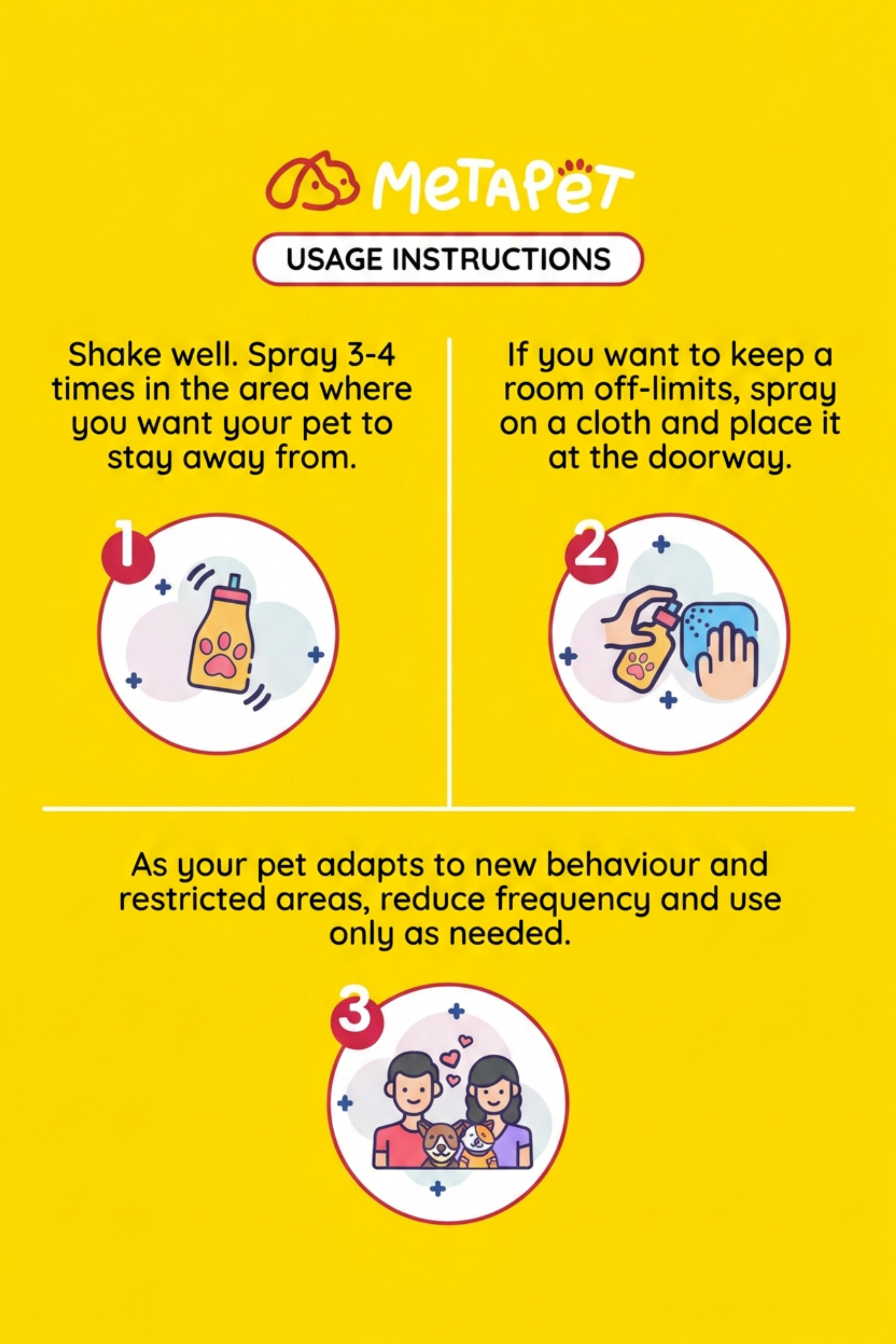
If your cat scratches or chews household items you would rather protect, a training deterrent spray such as MetaPet How to Say No — No-Scratch No-Chew Pet Training Spray is designed to be used on suitable household surfaces as part of a redirection routine, alongside providing appropriate outlets. It is a training aid rather than a medicine, is not a substitute for supervision or for removing hazards, and does not replace veterinary advice. Always spot-test on a hidden area first and follow the product instructions.
Special Situations Worth Flagging
Needles attached to thread
This raises the urgency further, because a sharp object is travelling with the strand. Treat any suspicion of a swallowed needle as an immediate emergency, and mention it specifically when you call.
Kittens and young cats
Young cats play harder, explore more, and have narrower digestive tracts. They are over-represented in these cases, so households with kittens need to be especially disciplined about tidying.
Seasonal decorations
Tinsel, ribbon and gift string cause a predictable seasonal cluster of cases. If you decorate, choose cat-safe alternatives and clear wrapping materials away promptly rather than leaving them on the floor.
Multi-cat households
You may not know which cat swallowed something. If string has gone missing and one cat is unwell, say so — and watch the others closely too.
Frequently Asked Questions
My cat swallowed thread but seems completely fine. Do I still need to call?
Yes. Cats often appear normal for a period before signs develop, and early assessment is far preferable to late intervention. A phone call costs nothing.
Could it just pass on its own?
Sometimes a short piece does pass uneventfully. The problem is that you cannot know in advance which cases will, and the ones that do not can become serious quickly. That judgement belongs to a veterinarian who has examined your cat.
What if I only see string under the tail?
Do not pull it, and do not cut it before speaking to your veterinarian. Call and describe exactly what you can see.
Are dogs affected too?
Dogs can also swallow linear objects, and it is serious in dogs as well. It is discussed most often in cats because feline behaviour and tongue anatomy make it considerably more common.
Is a hair tie really that dangerous?
Elastic hair ties are among the most frequently reported items in these cases. They are small, everywhere, and easy to overlook — which is exactly what makes them a problem.
The Bottom Line
Linear foreign bodies sit in a small group of feline problems where owner action in the first hours genuinely changes the outcome. The behaviour that leads to them is entirely normal cat behaviour, so the answer is environmental rather than disciplinary: remove the string-like objects, and give your cat better things to hunt.
If it has already happened, remember the two rules that matter most. Never pull on a strand you can see, from either end. And never adopt a wait-and-see approach, even if your cat looks well.
Phone your veterinary practice, describe what happened precisely, and follow their instructions. Cats seen early usually do considerably better than cats seen late, and that timing is the one part of the situation you control.