Destructive Chewing in Dogs: Causes and Solutions

You come home, open the door, and find the corner of the sofa reduced to stuffing. Or a shoe, or a baseboard, or the leg of a chair you actually liked. Destructive chewing is one of the most frustrating behaviors a dog owner faces, partly because of the cost and partly because it feels personal — as though the dog knew and did it anyway.
They did not. Chewing is a normal, healthy, hard-wired canine behavior. It relieves discomfort in a teething mouth, occupies an under-stimulated brain, discharges nervous energy, and simply feels good. A dog who chews destructively is not being spiteful; they are being a dog in an environment that has not given them an acceptable outlet, or in some cases a dog who is genuinely distressed.
The good news is that chewing responds well to management. The catch is that the approach depends entirely on why it is happening — and boredom, anxiety, teething and medical causes each need something different.
Important: This article shares general educational information for pet owners and is not a substitute for an in-person veterinary examination, diagnosis, or treatment. For any medical concern or emergency, contact your veterinarian promptly.
Chewing Is Normal — Destruction Is a Symptom
Dogs explore with their mouths in the way people explore with their hands. Puppies in particular use chewing to investigate texture, and adult dogs continue to chew because it is inherently satisfying. The instinct is not a flaw to be trained out. What can be changed is the target.
This distinction matters because it points to the strategy. The goal is never to stop a dog from chewing, which would be both impossible and unkind. The goal is to make the right things attractive, the wrong things unavailable, and the underlying need — whatever it is — properly met. A dog with nothing to do, nothing to chew and nowhere to put their energy will find their own solution, and you will not like it.
The Most Common Cause: Not Enough to Do
Boredom and under-stimulation account for a large share of destructive chewing in otherwise healthy adult dogs. A dog left alone for hours in an empty room, with no toys, no chews, no view and nothing to think about, is in a situation their brain is poorly equipped to tolerate. Chewing the furniture is not a failure of training; it is the only available activity.
Physical exercise helps but it is only half the answer. Mental work — sniffing, problem-solving, training, foraging — tires a dog in a way a walk around the block does not. Many owners are surprised at how much calmer a dog becomes when the mental side is addressed, even without increasing exercise time.
- Food puzzles and slow feeders: make the dog work for a portion of their daily food instead of handing it over in ten seconds.
- Scent games: hide treats around a room and let the dog find them; sniffing is genuinely tiring.
- Short training sessions: five minutes of teaching something new twice a day does real cognitive work.
- Rotate the toys: keep most of them put away and swap the selection every few days so they stay interesting.
- Long-lasting appropriate chews: choose ones suited to your dog's size and chewing style, and ask your veterinarian which types they consider safe — some hard items can fracture teeth.
- Sniffing walks: let the dog stop and investigate rather than marching them briskly to a fixed route.
Anxiety-Driven Chewing Looks Different
Chewing from distress has a distinct signature, and telling it apart from boredom is the single most useful diagnostic step you can take. Anxious chewing tends to occur specifically when the dog is left alone, tends to focus on exits and barriers — doors, window frames, crates, door handles — and is often accompanied by other signs of distress such as pacing, drooling, vocalizing, house soiling in an otherwise house-trained dog, or self-injury from trying to escape.
This is not a training problem that more exercise will fix. Separation-related distress is a genuine welfare issue, and dogs experiencing it are frightened, not naughty. Punishment makes it substantially worse, because it adds fear to an already fearful situation. If the pattern above sounds familiar, the right next step is a conversation with your veterinarian, who can rule out medical contributors and refer you to a qualified behavior professional. There are effective, humane approaches — but they require a proper plan rather than a gadget.
- Chewing only when alone: strongly suggests distress rather than boredom.
- Damage focused on doors and windows: escape attempts, not entertainment.
- Signs of panic on departure cues: picking up keys, putting on shoes — the dog reacts before you have left.
- Drooling, pacing, howling: distress signals that accompany the chewing.
Puppies and Teething
Puppies chew because their mouths hurt and because everything is new. Teething is genuinely uncomfortable, and chewing provides relief. This phase passes, but how you handle it shapes the adult dog's habits — a puppy who learns that table legs are satisfying does not simply outgrow the association.
The approach is straightforward: make the house boring and the toys interesting. Manage the environment so that inappropriate items are simply not available, supervise closely when the puppy is loose, and redirect calmly and immediately to an appropriate chew whenever the puppy targets something they should not. Reward the moment they take the right item. Chilled (not frozen solid) chew toys can be soothing for sore gums — check with your veterinarian about what is appropriate for your puppy's age.
Do not offer old shoes or discarded clothing as toys. A dog cannot distinguish between an old shoe and a new one, and you have just taught them that shoes are legitimate targets.
Management: Make the Wrong Choice Impossible
Training takes time. Management works immediately, and it prevents the dog from rehearsing the behavior while you work on the underlying cause. Every successful chew on a sofa arm makes the next one more likely, so removing the opportunity is not cheating — it is the foundation.
- Puppy-proof the room: cords secured, shoes away, remotes up, laundry in a closed basket.
- Use baby gates or a safe confinement area: a properly introduced crate or pen is a resting place, not a punishment, and must never be used as one.
- Supervise or contain: if you cannot watch the dog, they should be somewhere they cannot make a mistake.
- Give a chew before you leave: a dog occupied with something appropriate at the moment of departure has a better start.
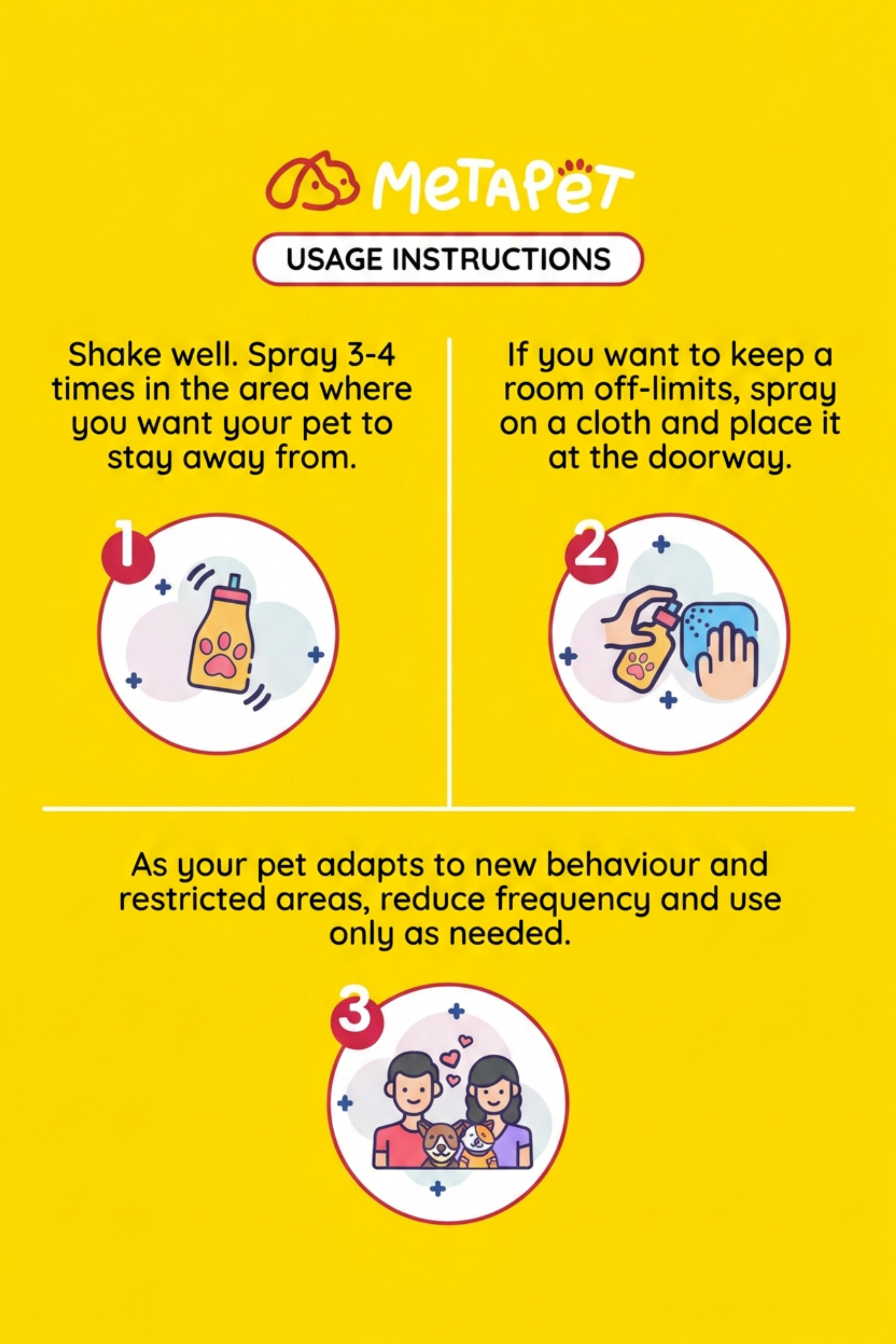
- Consider a deterrent on specific surfaces: MetaPet's How to Say No — No-Scratch No-Chew Training Spray is an assistive training spray made with naturally derived ingredients, designed to act as a gentle signal that helps guide your pet away from areas you would like to keep off-limits. It can be a useful part of a training plan alongside supervision, enrichment and redirection — it is not a treatment for anxiety and it is not a substitute for training or for veterinary advice. Test on a small hidden area of any surface first, and follow the product directions.
What Not to Do
Punishment after the fact does nothing except damage your relationship with your dog. Dogs do not connect a scolding with something they did an hour ago; the 'guilty look' owners describe is a response to your body language and tone in the moment, not evidence of remorse. All the dog learns is that your return is sometimes frightening — which, in a dog who is already anxious about being left, makes the underlying problem measurably worse.
- Do not scold on discovery: the connection you imagine is not being made.
- Do not use physical corrections or intimidation: these increase fear and can create aggression.
- Do not crate a distressed dog as a solution: confinement without addressing the anxiety often escalates the panic.
- Do not assume they will grow out of it: a rehearsed habit tends to consolidate, not fade.
When Chewing Is a Medical Problem
Not all chewing is behavioral. Dental pain, mouth injuries, nausea, and some medical conditions can drive chewing or licking behavior, and a sudden change in an adult dog who was previously not a chewer is a genuine reason to see your veterinarian rather than reaching for a training plan.
Of particular concern is a dog who eats what they chew, or who consumes non-food items such as fabric, plastic, rocks or soil. This behavior can lead to an intestinal obstruction, which is a surgical emergency, and it may have medical or behavioral drivers that need proper investigation. If your dog swallows a foreign object, or if you notice vomiting, loss of appetite, lethargy or straining, contact your veterinarian immediately. This is not something to monitor at home.
Building a Realistic Daily Routine
Most chewing problems in healthy adult dogs improve substantially when the day has structure. That does not mean an exhausting schedule — it means predictable outlets for energy, mind and mouth, distributed through the day rather than crammed into one evening walk.
- Morning: a real walk with time to sniff, plus a few minutes of training before you leave.
- Departure: an appropriate long-lasting chew or a food puzzle, given calmly and without fuss.
- Midday if possible: a break, a visit, or a walk — long, unbroken alone time is the hardest thing to ask of a dog.
- Evening: exercise, a training game, and a settled chew session while you relax.
- Always available: a small rotating selection of appropriate toys and a comfortable resting place.
Consistency across the household matters too. If one person allows the dog to chew a slipper and another does not, the dog learns that the rule depends on who is watching — which is not a rule at all.
Frequently Asked Questions
Will neutering stop destructive chewing?
No. Chewing is not primarily a hormonal behavior, and spaying or neutering should be discussed with your veterinarian on its own merits rather than as a fix for chewing.
How long does puppy teething last?
Puppies work through a teething period during their first months as adult teeth come in, and the intensity of chewing often eases afterward. Your veterinarian can tell you what to expect for your puppy and check that the teeth are coming in normally.
Are all chew toys safe?
No. Very hard items can fracture teeth, and small or breakable items can be swallowed. Choose chews appropriate to your dog's size and chewing strength, supervise, discard worn items, and ask your veterinarian what they recommend.
My dog only chews when I am out. Is that separation anxiety?
It might be, or it might be boredom during the only time the dog is unsupervised. The other signs — panic on departure, damage at exits, drooling, vocalizing — help tell them apart. If you suspect distress, speak to your veterinarian.