Cat Trees and Vertical Space: Why Cats Need Height

Watch a cat explore a new room and you usually see the same sequence: a cautious lap of the floor, then a long look upward. Cats are climbing animals, built to use trees and ledges as lookouts and escape routes. Indoors that instinct does not switch off; it attaches itself to a bookshelf, a refrigerator top, or the tallest sofa.
Vertical space is not a decorative extra. It is usable territory. A home with only floor gives a cat one plane to live on, while safe, reachable height multiplies the same square footage.
This guide covers why cats climb, how to choose and place a tree, scratching, and adapting height for older or heavier cats.
Important: This article shares general educational information for pet owners and is not a substitute for an in-person veterinary examination, diagnosis, or treatment. For any medical concern or emergency, contact your veterinarian promptly.
Why Cats Seek Elevation
Height solves several problems at once, which is why the pull is so strong.
- Safety: a perch above head level keeps a cat clear of dogs, toddlers, and vacuums.
- Surveying territory: a wide view of doorways and food areas without patrolling on foot.
- Retreat: somewhere to withdraw to rather than a place to be cornered.
- Warmth: warm air rises, and cats choose the warmest resting spot available.
- Confidence: cats who control their distance from people and pets move through a home more freely.
A cat who keeps landing on the counter is usually reporting that it is the only elevated surface with a view.
Vertical Space as Usable Territory
Cats map a home as resting spots and routes, and a shelf route counts as much as a hallway. Three secure levels expand a cat's world in a studio apartment.
Aim for a climbable path rather than one tall island: a low landing, a middle step, a top platform. A perch with one long jump down is less useful than a lower one with two exits.
Cat Trees, Perches, Shelves, and Repurposed Furniture
Most homes combine two or three.
- Cat trees: freestanding units bundling climbing, scratching, perching, and hiding into one piece.
- Window perches: a shelf or hammock adds a view and sunlight, which many cats value more than height; check the window screen first.
- Wall shelves: mounted steps create a route above the floor, but need fixings into studs.
- Repurposed furniture: a cleared bookshelf or dresser top works when it is stable and reachable in stages.
A surface a cat cannot grip is one a cat will slip on. Add a carpet tile or a rubber-backed mat to varnished wood or glossy laminate.
How to Choose a Cat Tree and Where to Put It
Stability outranks every other feature. A tree that rocks when a cat lands on top will be abandoned, and one bad experience can put a cat off for months.
What to look for
- A wide, heavy base: a broad footprint that resists a firm push at the top.
- Height in stages: platforms spaced so a cat steps rather than leaps, largest gaps near the bottom.
- Platform size: a large cat needs a platform supporting the whole body, not a narrow perch.
- Surfaces: sisal holds up to claws; carpet is softer but frays and can catch a worn claw.
- Enclosed cubbies: a covered box suits a shy cat, best with two openings so nobody is trapped.
- Cleaning and repair: removable covers and replaceable posts extend the unit's life.
Where to put it
- Near a window: birds, traffic, and weather give a perched cat something to do.
- Away from noisy appliances: washers and dryers make a good spot feel unsafe.
- Not blocking an exit: keep walkways clear so a cat is never forced past the tree.
- Never the only way out of a corner: a dead-end perch can become a trap during a squabble.
Window placement comes with one condition: check the screen first. Ordinary insect screens are not built to hold a cat's weight, and a cat who leans or pushes can pop one out of its frame. Any window near a perch needs a secure, well-fitted screen your cat cannot push out, and an open window should never sit behind a perch on the assumption the screen will hold. Balcony railings and the gaps between and beneath them need the same check; see window and balcony safety. Treat a fall from a height as an emergency even if your cat walks away.
Scratching Is Part of the Same Need
Climbing and scratching come from the same instincts, which is why a good tree includes scratching surfaces. Scratching is normal, healthy behavior, and a cat with no acceptable outlet will find an unacceptable one.
- Nail care: scratching helps shed the worn outer sheath of the claw.
- Stretching: a full-body pull along a post exercises the shoulders, back, and forelimbs.
- Marking: paw scent glands leave a chemical signal, and the visible marks are a second, longer-lasting message.
Offer both orientations. Some cats stretch upward on a tall post, others rake a flat pad, and many use both. Place pads where the cat already scratches.
Punishment does not work. Scolding or startling does not remove the need to scratch; it teaches the cat to scratch when you are absent. Redirect instead: put an appealing post beside the chosen spot, make it interesting with catnip or play, reward any use, then make the original surface less inviting.
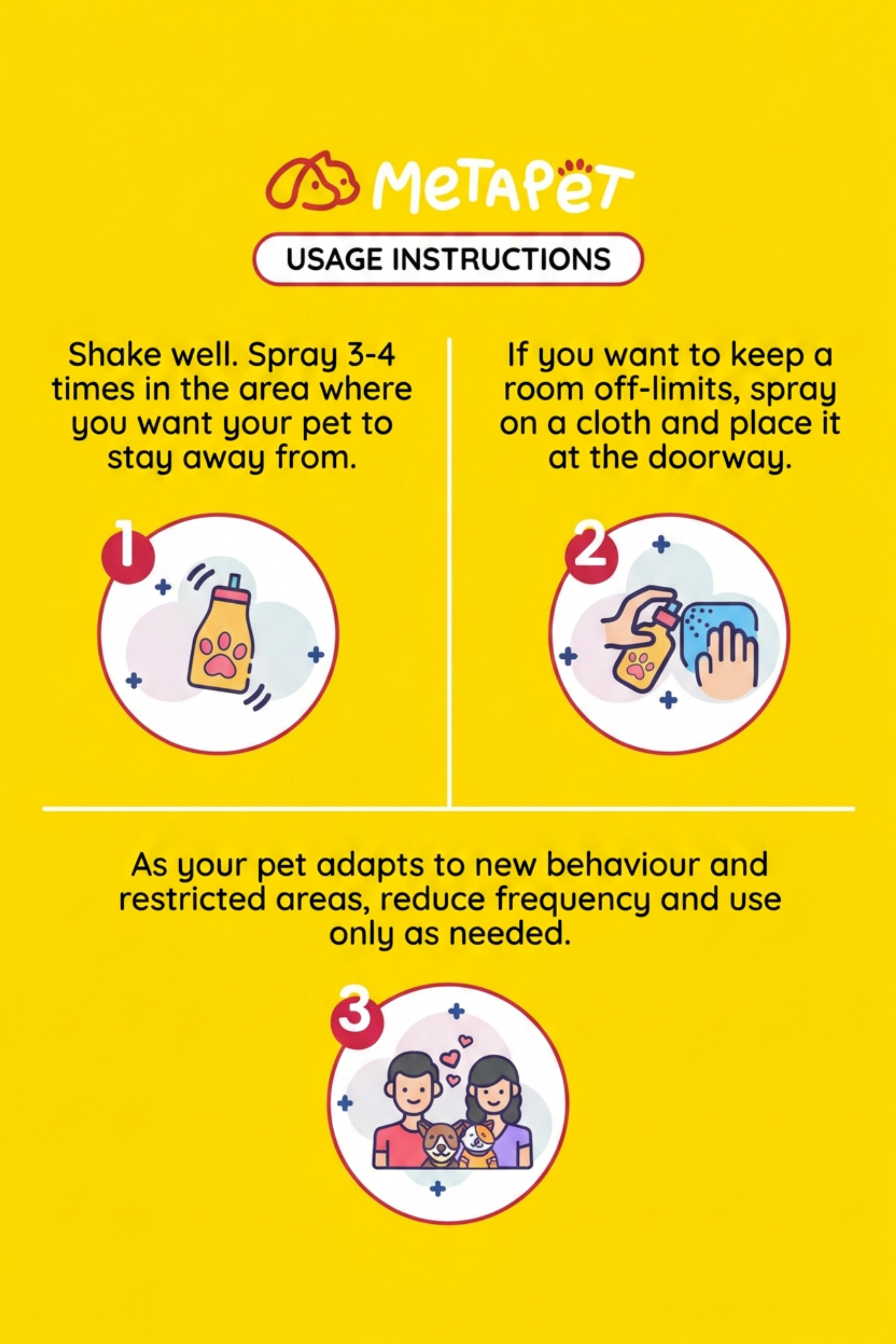
Some owners use a deterrent-scented product such as MetaPet How to Say No - No-Scratch No-Chew Pet Training Spray for Cats & Dogs at that last step, designed to help make a treated surface smell less appealing while you reward a better option nearby. Test on a hidden area first and follow the label. Products like this complement, and never replace, proper veterinary care and behavioral advice.
Multi-Cat Homes and Dog-Free Height
Friction between cats is frequently about space and access rather than personality. Vertical distance reads as social distance, so a cat on a shelf and a cat on the sofa are not competing.
- One perch per cat, plus one: spare capacity means no cat has to displace another to rest.
- Spread resources out: food, water, litter boxes, and resting spots in different areas.
- Watch the choke points: narrow hallways and the approach to a litter box are where standoffs happen.
- Dog-free height: a cat needs at least one resting place and one feeding spot a dog cannot reach.
If tension persists, ask your veterinarian for a behavior assessment.
Kittens, Seniors, Arthritic Cats, and Heavier Cats
The tree that suits an agile three-year-old can be wrong for a kitten, a senior, or a heavier cat. The risk to plan for is the way down: a hard landing is harder on aging joints than the climb was.
- Reduce the gaps: closer spacing lets a stiff cat step down instead of dropping.
- Add ramps and steps: a ramp or low stool at the base creates a gentle first stage.
- Cap the height: a shorter tree that is fully used beats a tall one the cat abandons.
- Cushion the landing: a rug under the tree softens the final step down.
- Widen the platforms: flatter, larger surfaces are easier for a big cat to turn on.
Kittens climb beyond their coordination, so supervise early access. Weight management is worth discussing with your veterinarian, since carrying less weight makes climbing and landing easier.
Safety, Introducing a New Tree, and Upkeep
A cat tree is furniture that gets landed on, so give it the attention you would give a bookshelf.
- Anchor tall units: a wall strap or bracket into a stud for anything above waist height.
- Check for wobble monthly: tighten bolts and retire a unit whose joints have loosened.
- Manage cords: keep blind cords, chargers, and dangling toy strings away from perches.
- Avoid loops: a looped toy can catch a collar, so use short attachments and a breakaway collar.
- Inspect surfaces: trim frayed carpet and replace worn sisal before a claw can snag.
Introduce a new tree slowly. Put it where the cat already spends time, rub a familiar blanket on the platforms to transfer scent, and leave it alone for a day or two. Then add treats on the levels and a wand toy dragged up the post. Never lift a cat onto a tree; that removes the cat's choice and often creates avoidance.
For a cat slow to settle after a rearranged room, an optional complement such as MetaPet Heyy Calm Down - Natural Calming Drops for Cats may be used alongside, not instead of, the changes described here. Follow the label, keep feeding and play predictable, and speak with your veterinarian before adding anything new for a cat with a health condition or on medication. Anything of this kind is an addition to veterinary care, never a substitute for it.
Myth vs. Fact: Cats and Height
- Myth: Climbing on furniture is just bad manners. Fact: It is normal behavior tied to safety, warmth, and surveillance, and it often eases once better elevated options exist.
- Myth: Cats always land safely, so a fall is nothing to worry about. Fact: Falls can cause real injuries, and a cat limping or reluctant to move afterward needs veterinary attention.
- Myth: The taller the cat tree, the better. Fact: Stability, platform size, and manageable steps matter more than raw height.
- Myth: Scratching can be trained out of a cat. Fact: Scratching is a normal need, so the goal is redirecting it rather than stopping it.
Frequently Asked Questions
How many perches does one cat need?
At least two or three elevated spots in the rooms the household uses, so the cat can pick between a view, a quiet corner, and a spot near you, plus a spare in multi-cat homes.
My cat only uses the bottom level. Is the tree wrong?
Often the steps are too far apart, the top platform is too small, or the unit shifts under weight. Add a step at the base, check for wobble, and try moving it nearer a window first.
Will a cat tree stop my cat from scratching the couch?
It can help, but only if the new option sits where the cat already scratches and gets rewarded when used. Making the couch less appealing is a supporting step, not the first one.
Your Cat Tree Setup and Safety Checklist
- Stability: push firmly at the top; no rocking or sliding.
- Anchoring: tall units strapped or bracketed to a wall stud.
- Steps: platforms spaced so your cat steps rather than leaps.
- Platform size: big enough to lie down fully and turn around.
- Scratching: one tall vertical post and one horizontal pad available.
- Placement: near a window, away from loud appliances, not blocking a doorway.
- Windows and balconies: a secure, well-fitted screen at any window near a perch, and no open window behind one.
- Escape routes: aim to give each perch more than one way down, and avoid perches whose only exit is a long jump.
- Cords: blind cords tied up, no loops a collar can catch.
- Multi-pet: one elevated spot the dog or other cat cannot reach.
- Monthly check: bolts tightened, frayed carpet and worn sisal replaced.
When to Call Your Veterinarian
Cats hide discomfort well, and a change in how a cat uses height is often the first visible sign something has changed.
Call your veterinarian promptly if
- Your cat suddenly stops jumping or climbing to spots it used before.
- You notice hesitation or false starts before a jump.
- Your cat misjudges a jump or scrabbles to hold a landing.
- Your cat limps or is reluctant to move after a fall.
- Your cat starts waking, pacing, or calling at night, or hiding.
- Scratching becomes repetitive overgrooming or focuses on one spot.
- You see stiffness after rest, stair reluctance, or new litter box habits.
- Grooming declines and the coat mats, or your cat seems withdrawn or less playful.
Seek emergency veterinary care immediately if
- Your cat falls from a window, balcony, or other height, even if it gets up and seems unhurt.
- Your cat falls and then cannot bear weight, will not move, or cries when touched.
- Your cat is suddenly unable to walk or is dragging the hind limbs.
- Your cat is breathing with an open mouth, panting, or straining to breathe.
- Your cat has collapsed, is unresponsive, or has had a seizure.
- Your cat is caught by a collar or string, or has swallowed string or part of a toy.
- There is heavy bleeding or an obvious limb deformity.
- Your cat is straining in the litter box, producing little or no urine.
If you are unsure which list a sign belongs in, call your veterinarian or an emergency veterinary hospital.